Budapest Gambit
Starting position
Engine ready — step through to see live evals.
Press ▶ Watch to play the line out, or Next to step through it — the engine evaluates every position.
The Budapest Gambit strikes at 1.d4 with 2...e5, and unlike its cousin the Englund, it is far sounder than it looks: in the main lines Black regains the pawn by force and reaches a fully playable game. Engines give White only a modest pull, which is a fair price for dragging queen's pawn players into sharp, unfamiliar territory on move two. It has been a respected surprise weapon for a century, and at club level it is a genuinely dangerous one.
The idea in one line
Offer the e-pawn, chase it with ...Ng4, then gang up on e5 with ...Nc6, ...Bb4+ and ...Qe7 until it falls. Black gets fast development and active pieces; White keeps a small space edge at best.
Key ideas
- 2...e5 only works because c4 was played: after 3.dxe5 Ng4 the pawn is attacked and White's natural defenders are awkward, which is the gambit's engine room.
- The regain is mechanical: ...Nc6 adds an attacker, ...Bb4+ develops with tempo, ...Qe7 adds the third hit, and e5 cannot be held forever.
- The honest verdict: this is a real opening, not a trick. White's best lines keep a small, stable edge (mostly space and the bishop pair), nothing worse than many respectable defences concede.
- Practical value is the selling point: London and Catalan players never wanted this position, and most club opponents face the Budapest a handful of times a year at most.
Plans for each side
White: The main line holds the pawn temporarily with 4.Bf4, develops with Nf3, and meets ...Bb4+ with Nbd2, returning e5 at the right moment (7.a3 forces the trade on d2 or the capture on e5) to keep the bishop pair and a small space plus with pawns on c4 and e3.
Black: Follow the drill: ...Ng4, ...Nc6, ...Bb4+ and ...Qe7, regain e5, then castle and play actively against White's queenside: the d-file, the e5 outpost for a knight, and quick piece pressure are Black's compensation for the slightly passive structure.
Common mistakes to avoid
- Know the regain mechanism exactly: if you improvise after 4.Bf4 and never assemble the ...Nc6, ...Bb4+, ...Qe7 battery, you are just a clean pawn down with a wandering knight.
- Do not confuse the Budapest with the Fajarowicz (3...Ne4): that knight lunge is a far riskier gamble that engines treat much more harshly, and the two need completely different preparation.
- After you regain the pawn, do not relax: White's space edge grows if you shuffle. Castle quickly and create piece activity before the bishop pair starts to tell.
The main line, explained
2… e5...e5, the Budapest. It hits d4 immediately and only makes sense once White has committed the pawn to c4.
3. dxe5dxe5 accepts; declining leaves Black comfortable, so this is the critical test.
3… Ng4...Ng4 chases the pawn at once, the move that defines the gambit. The knight is safe here for exactly as long as the attack on e5 lasts.
4. Bf4Bf4 is the main line: White holds the extra pawn and asks Black to prove the regain.
4… Nc6...Nc6 adds the second attacker; the siege of e5 is under way.
5… Bb4+...Bb4+ develops with check and gains a tempo. The block 6.Nbd2 is forced in spirit, since 6.Nc3 allows ...Bxc3+ wrecking White's pawns.
6. Nbd2Nbd2 keeps the structure intact but pins itself; White plans a3 to resolve the tension.
6… Qe7...Qe7 is the third hit on e5: the pawn now falls by force, for example 7.a3 Ngxe5 8.Nxe5 Nxe5 with a level game where White keeps only a small pull.
Frequently asked
Is the Budapest Gambit sound?
Very nearly. Black regains the pawn by force in the main lines, and engines give White only a small edge, mostly space and the bishop pair. It is a legitimate surprise weapon even at classical time controls, unlike the truly dubious anti-d4 gambits.
Does Black always get the pawn back?
In the main lines, yes: the ...Ng4, ...Nc6, ...Bb4+, ...Qe7 battery wins e5 by force. Only mishandling the move order, or wandering into the separate Fajarowicz variation, leaves Black material down without compensation.
When can I play the Budapest?
Only after 1.d4 Nf6 2.c4: the gambit needs White's c-pawn committed so the e5-pawn lacks natural defenders. Against 2.Nf3 systems it simply is not available, which keeps your preparation footprint small.
Traps in the Budapest Gambit
- Kieninger Trap: checkmate (smothered)
- Fajarowicz Trap: checkmate
More openings to explore
Albin Countergambit
Black vs 1.d4 · D08-D09
Learn & play ›King's Indian Defense
Black vs 1.d4 · E60–E99
Learn & play ›Knowing the moves of the Budapest Gambit is not the same as knowing why they work. Use Claude? BetterChess gives it a real engine, so it explains this opening from the board in front of you instead of from memory.
BetterChess is a practice tool — we make no guarantee you'll reach 1800 or any rating. The lines here are standard, well-established opening theory, and every move is checked legal with the same engine the board runs.
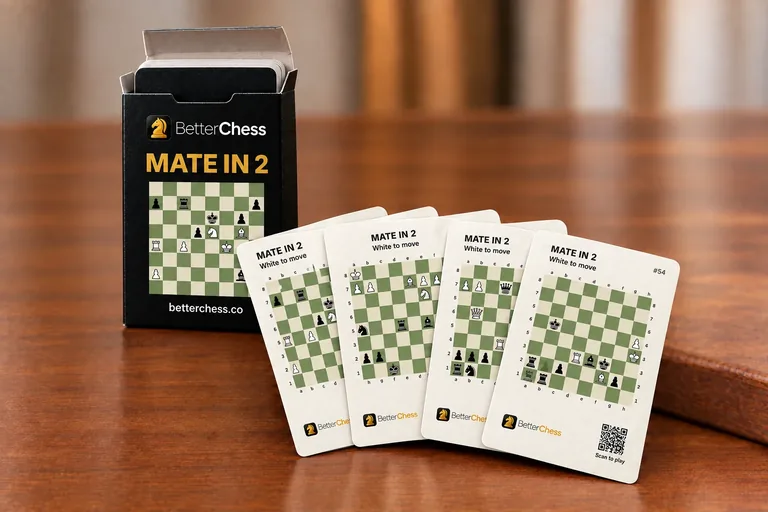
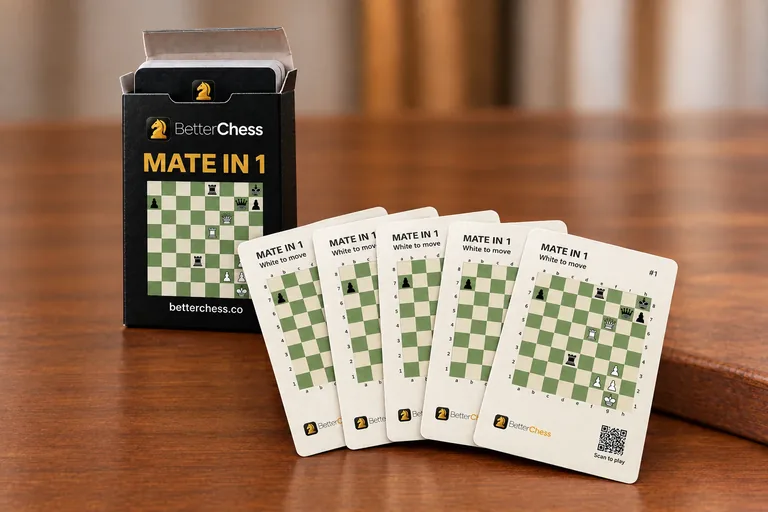
PRINTED CHESS PUZZLE CARDS
Chess puzzle playing card decks
54 poker-size cards in a tuck box. Puzzle on the front, solution on the back.