Colle System
Starting position
Engine ready — step through to see live evals.
Press ▶ Watch to play the line out, or Next to step through it — the engine evaluates every position.
The Colle System is a friendly, low-theory way to play 1.d4: a simple triangle of pawns on d4, e3 and c3, the bishop developed to d3, knights to f3 and d2, then castle. The whole plan builds toward one central break — e4 — which opens the position for a kingside attack. Like the London, you play nearly the same moves against most of Black's set-ups, so it's ideal for busy club players.
The idea in one line
Build the d4-e3-c3 pawn triangle, develop Bd3, Nbd2 and Nf3, castle, and prepare the e4 break to open lines toward Black's king.
Key ideas
- The whole system points at one move: e3-e4. Prepare it with Nbd2, and when it lands the light-squared bishop on d3 springs to life.
- Bishop to d3 aims at h7 — paired with Nf3 and a later knight on e5 or queen on the b1-h7 diagonal, it fuels a classic kingside attack.
- It's a 'system': learn the set-up and the e4 plan, then repeat the moves against almost anything Black plays.
- The structure is solid and hard to crack quickly, so you rarely get into early trouble while you prepare the break.
Plans for each side
White: Complete the d4-e3-c3 set-up with Bd3, Nbd2, O-O, then play for e4; after the centre opens, use Bd3 and the knights to attack Black's kingside.
Black: Strike at the centre with ...c5 and ...Nc6, develop the light-squared bishop actively (often ...Bd6 or ...Be7 and a quick ...e5 or ...cxd4), and prevent a free e4 break.
Common mistakes to avoid
- Don't play e4 prematurely — prepare it with Nbd2 (and sometimes Re1 or Qe2) so it isn't just swapped off harmlessly.
- If you let your light-squared bishop on d3 get traded for no reason, the kingside attack loses its main piece.
- Playing passively without ever achieving e4 hands Black easy, comfortable equality; the break is the point of the system.
The main line, explained
2. Nf3Nf3 — natural development controlling e5 and supporting the coming centre.
3. e3e3 builds the Colle triangle and opens the f1-bishop's path to d3.
4. Bd3Bd3 — the key bishop, aiming at h7 and supporting the e4 break.
4… c5c5 — Black challenges d4, the standard counter to the Colle.
5. c3c3 completes the d4-e3-c3 triangle and holds the centre against ...c5.
5… Nc6Nc6 — Black piles pressure on d4; White will continue Nbd2, O-O and aim for e4.
Frequently asked
How is the Colle different from the London?
Both are easy 1.d4 systems, but the London develops the dark-squared bishop outside the pawn chain to f4 first, while the Colle keeps it home behind e3 and focuses on the e4 break and a kingside attack.
What is the main idea of the Colle?
The e4 break. You set up d4, e3, c3, Bd3 and Nbd2, castle, and then play e4 to open the centre and launch your bishop and knights at Black's king.
Is the Colle good for beginners?
Yes. It's repeatable, solid, and teaches a clear plan, so you don't need much theory. The main thing to learn is how and when to prepare the e4 break.
More openings to explore
London System
Queen's Pawn (1.d4) · D02
Learn & play ›Queen's Gambit
Queen's Pawn (1.d4) · D06–D69
Learn & play ›Knowing the moves of the Colle System is not the same as knowing why they work. Use Claude? BetterChess gives it a real engine, so it explains this opening from the board in front of you instead of from memory.
BetterChess is a practice tool — we make no guarantee you'll reach 1800 or any rating. The lines here are standard, well-established opening theory, and every move is checked legal with the same engine the board runs.
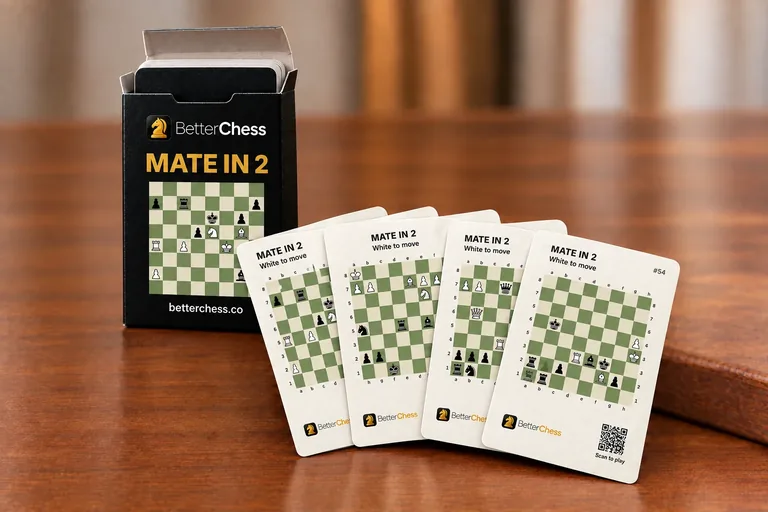
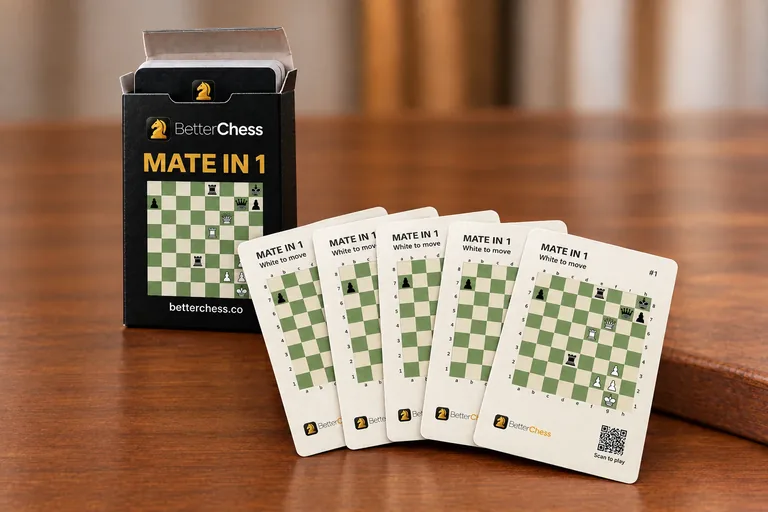
PRINTED CHESS PUZZLE CARDS
Chess puzzle playing card decks
54 poker-size cards in a tuck box. Puzzle on the front, solution on the back.