Würzburger Trap
Part of the Vienna Gambit: see the full opening guide
Starting position
Engine ready — step through to see live evals.
Press ▶ Watch to play the line out, or Next to step through it — the engine evaluates every position.
The Würzburger Trap, named around 1930 for the German banker Max Würzburger, is the Vienna Gambit's answer to Black's most tempting idea: the check on h4. In the King's Gambit that check is often strong; here it is the start of a forced sequence in which Black's queen gets hunted across the board, the queens come off, and a greedy bishop ends its life in a cage on c2.
The idea in one line
After the correct 3...d5 4.fxe5 Nxe4 5.d3, Black goes wrong with 5...Qh4+?. White blocks with 6.g3, and after 6...Nxg3 7.Nf3! the queen is pushed around while 8.Nxd5 hits c7. The forced sequence 9.Nf4 Bxf3 10.Nxh5 Bxd1 11.hxg3 trades everything, and the greedy 11...Bxc2? meets 12.b3!: the bishop is trapped and White wins a piece.
How the trap works
The Vienna Gambit 1.e4 e5 2.Nc3 Nf6 3.f4 d5 4.fxe5 Nxe4 5.d3 asks the e4 knight a question, and 5...Qh4+? feels like the punishment White deserves for weakening his kingside. It is the trap. 6.g3 forces 6...Nxg3, and now 7.Nf3! is the move Black missed: instead of taking the knight (the h1 rook is poisoned bait), White gains a tempo on the queen. After 7...Qh5 8.Nxd5! White threatens the fork on c7, and 8...Nxh1? 9.Nxc7+ Kd8 10.Nxa8 is simply good for White. So Black plays 8...Bg4, and the forcing sequence runs 9.Nf4 Bxf3 10.Nxh5 Bxd1 11.hxg3: queens and a pair of minor pieces have left the board, and material is dead level. Here Black's bishop must retreat from d1, and the pawn on c2 looks free. 11...Bxc2? takes it, and 12.b3! closes the cage: b3 and d3 are White pawns, d1 is covered by the king, b1 by the a1 rook, and Kd2 or Rh2 picks the bishop up next move. Even 12...Bb4+ 13.Bd2 Bxd2+ 14.Kxd2 changes nothing. White wins a piece for a pawn.
The move that springs it
11… Bxc2 — 11...Bxc2? (ply 22) is the move that finally loses material: the bishop grabs a pawn in the corner of the board where it has no squares, and 12.b3 shuts the door. The move that started all the trouble was 5...Qh4+?, which looks aggressive but commits the queen to a forced, tempo-losing tour. Retreating with 11...Bg4 or 11...Bh5 instead would have kept material level.
How to avoid it
As Black in the Vienna Gambit, resist the h4 check: after 4...Nxe4 5.d3 the sound moves are 5...Nxc3 or 5...Bb4, keeping the game normal. If you do end up in the forced sequence, settle for level material: retreat the bishop with 11...Bg4 and accept that White is slightly more comfortable. The one thing you must not do is grab the c2 pawn: any bishop that walks into c2 with White pawns on b3 and d3 is never coming home.
The full line, explained
3… d5...d5!: the correct reply to the Vienna Gambit, striking the center before taking anything.
5… Qh4+...Qh4+? starts the trap. 5...Nxc3 or 5...Bb4 keep Black comfortable instead.
6… Nxg3...Nxg3 wins a pawn and eyes h1, but the knight will stand offside for the rest of the line.
7. Nf3Nf3! the point: the rook on h1 stays poisoned while White gains a tempo on the queen.
8. Nxd5Nxd5 hits c7. Grabbing with 8...Nxh1? 9.Nxc7+ Kd8 10.Nxa8 just favors White.
9. Nf4Nf4 hits the queen yet again. Every Black piece is being asked to move twice.
10. Nxh5Nxh5: the queens come off by force. After 10...Bxd1 11.hxg3 material is exactly level.
11… Bxc2...Bxc2? the fatal pawn grab. The bishop enters a box with only three exits, all covered.
12. b3b3!: Bxb3, Bxd3, Bd1 and Bb1 all lose the bishop at once, and Kd2 or Rh2 wins it on c2. A piece falls.
Frequently asked
Where exactly does Black go wrong in the Würzburger Trap?
Twice. 5...Qh4+? commits the queen to a forced sequence in which White develops with gain of time (5...Nxc3 or 5...Bb4 are correct). Then, after the forced queen trade, 11...Bxc2? loses a piece on the spot to 12.b3. Stop at either fork and Black stays close to equal.
Why can't the bishop escape from c2?
Look at its four moves: Bxb3 meets axb3, Bxd3 meets Bxd3, Bd1 meets Kxd1, and Bb1 meets Rxb1. If it stays put, Kd2 or Rh2 attacks it next move and nothing can defend it in time; even the spite check 12...Bb4+ 13.Bd2 Bxd2+ 14.Kxd2 leaves the c2 bishop just as dead.
More traps to learn
Noah's Ark Trap
Ruy Lopez (1.e4 e5) · Wins a piece (traps the bishop)
Learn & play ›Mortimer Trap
Ruy Lopez, Berlin (1.e4 e5) · Wins a piece
Learn & play ›Every trap works until your opponent does not play into it — and then the same move often loses a piece. That is exactly what BetterChess catches: it checks the position instead of recognising the pattern.
A trap only works if your opponent makes the mistake — strong players sidestep these, which is why each page also shows how to avoid it. Every line here is checked legal with the same engine the board runs, and every checkmate is verified.
PRINTED CHESS PUZZLE CARDS
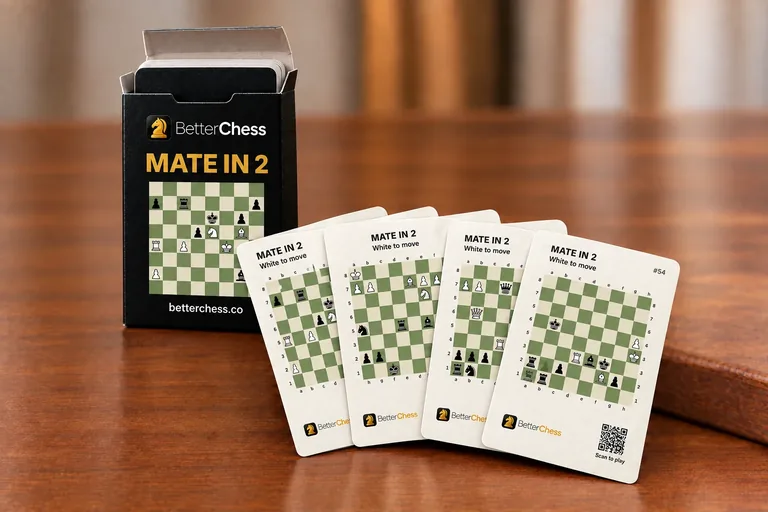
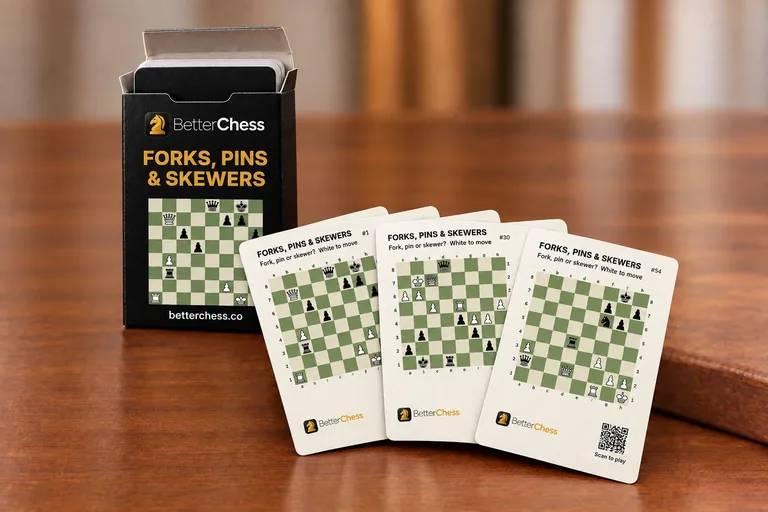
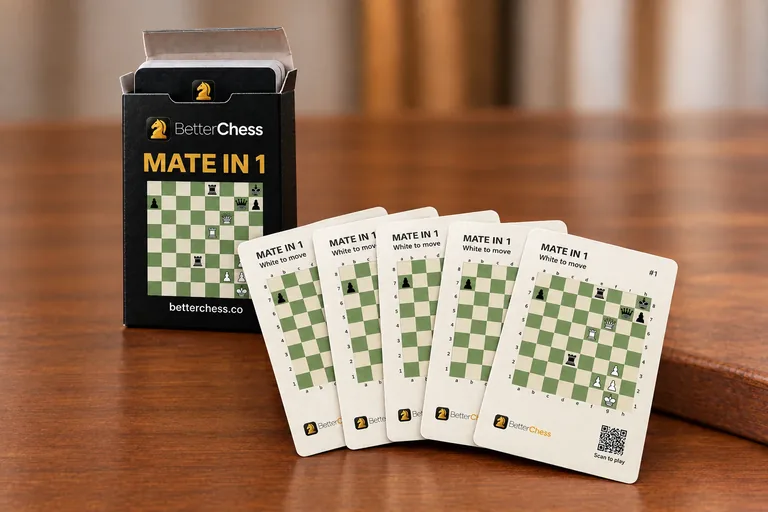
Chess puzzle playing card decks
54 poker-size cards in a tuck box. Puzzle on the front, solution on the back.