Tarrasch Trap
Part of the Ruy Lopez (Spanish): see the full opening guide
Starting position
Engine ready — step through to see live evals.
Press ▶ Watch to play the line out, or Next to step through it — the engine evaluates every position.
Two different Ruy Lopez traps carry Siegbert Tarrasch's name, and unlike most named traps, he actually sprang them against masters in tournament games. This page shows the Steinitz-variation version, sometimes called the Dresden Trap. Tarrasch published the analysis in 1891; eighteen months later Georg Marco walked straight into it at Dresden 1892, and Tarrasch reportedly spent five minutes of thought on the entire game. The losing move is the most natural one in chess: castling.
The idea in one line
In the old Steinitz Defense, White plays 7.Re1 and quietly loads the e-file. The natural 7...O-O?? then loses at least a pawn by force to 8.Bxc6 and 9.dxe5, and Marco's attempts to win the pawn back cost him a full piece by move 18.
How the trap works
After 1.e4 e5 2.Nf3 Nc6 3.Bb5 d6 4.d4 Bd7 5.Nc3 Nf6 6.O-O Be7, White plays 7.Re1, and the position looks completely normal. But castling now loses material by force: 7...O-O?? 8.Bxc6 Bxc6 9.dxe5 dxe5 10.Qxd8 Raxd8 11.Nxe5! and White has simply won the e5-pawn, because the e-file pressure defuses every recapture. Black's best is to accept a pawn-down position with 11...Bd7. Marco instead tried to regain it: 11...Bxe4 12.Nxe4 Nxe4, and now the finesse 13.Nd3! (the greedy 13.Rxe4?? loses to 13...Rd1+ 14.Re1 Rxe1#, Black's counter-trap). The e4-knight is now pinned against the e7-bishop and cannot escape: 13...f5 14.f3! forces matters, and after 14...Bc5+ 15.Nxc5 Nxc5 the knight seems safe, but 16.Bg5! attacks the d8-rook, 16...Rd5 17.Be7! forks the f8-rook and the c5-knight, and after 17...Re8 18.c4! the d5-rook is attacked and must abandon the knight: 18...Rd7 19.Bxc5, or 18...b6 19.cxd5. Marco resigned after 18.c4, a piece down in every line.
The move that springs it
7… O-O — 7...O-O?? (ply 14) is the losing move, which is what makes this trap so instructive: castling is the move every improving player has been taught to hurry up and play. Here it loses at least a pawn by force because the e5-pawn cannot survive the coming liquidation on c6, e5 and d8. Correct was 7...exd4, resolving the central tension first, when 8.Nxd4 O-O gives Black a solid game.
How to avoid it
In the old Steinitz Ruy Lopez, the pawn on e5 is a permanent responsibility: before castling, make sure it survives the sequence Bxc6, dxe5 and Nxe5. The practical rule from this game: resolve the central tension with ...exd4 before you castle in this structure. And if you have already fallen in, take the small loss: 11...Bd7 leaves you a pawn down but fighting, while chasing the e4-pawn like Marco walks into 13.Nd3!, when the pin against the e7-bishop and the two-rook geometry cost a full piece.
The full line, explained
7. Re1Re1 loads the e-file and sets one of the oldest published traps in the Ruy Lopez. Nothing looks wrong yet.
7… O-O...O-O?? is the losing move: castling walks into a forced liquidation that wins the e5-pawn. 7...exd4 was correct.
11. Nxe5Nxe5! collects the pawn. Best now is 11...Bd7, staying only a pawn down; Marco instead tries to win it back.
11… Bxe4...Bxe4?! chases the pawn and sinks deeper. Every recapture down the e-file was prepared by 7.Re1.
13. Nd3Nd3! is the finesse. The greedy 13.Rxe4?? loses to 13...Rd1+ 14.Re1 Rxe1#, so White covers e1 and keeps the e4-knight pinned against the e7-bishop.
14. f3f3! attacks the pinned knight a second time. It cannot move because the e7-bishop hangs with check ideas gone.
16. Bg5Bg5! switches targets to the d8-rook along the h4-d8 diagonal. Black's pieces start tripping over each other.
17. Be7Be7! forks the f8-rook and the c5-knight through the empty d6-square.
18. c4c4! decides: the d5-rook is attacked and every way to keep defending the knight fails, for example 18...Rd7 19.Bxc5 or 18...b6 19.cxd5. Marco resigned.
Frequently asked
Which Tarrasch Trap is this?
The Steinitz-variation version from Tarrasch vs Marco, Dresden 1892, sometimes called the Dresden Trap. There is a second Tarrasch Trap in the Open Ruy Lopez that caught Zukertort in 1887 and Gunsberg in 1890. Both are named for Siegbert Tarrasch, who published them and then won with them against masters.
Is castling really the losing move?
In this exact position, yes. After 7.Re1, the natural 7...O-O loses at least a pawn by force to 8.Bxc6 Bxc6 9.dxe5, because the liquidation on d8 and e5 leaves the e5-pawn unprotected against 11.Nxe5. Black had to play 7...exd4 first. Marco's attempt to regain the pawn then lost a full piece to the pin and fork sequence.
More traps to learn
Noah's Ark Trap
Ruy Lopez (1.e4 e5) · Wins a piece (traps the bishop)
Learn & play ›Mortimer Trap
Ruy Lopez, Berlin (1.e4 e5) · Wins a piece
Learn & play ›Every trap works until your opponent does not play into it — and then the same move often loses a piece. That is exactly what BetterChess catches: it checks the position instead of recognising the pattern.
A trap only works if your opponent makes the mistake — strong players sidestep these, which is why each page also shows how to avoid it. Every line here is checked legal with the same engine the board runs, and every checkmate is verified.
PRINTED CHESS PUZZLE CARDS
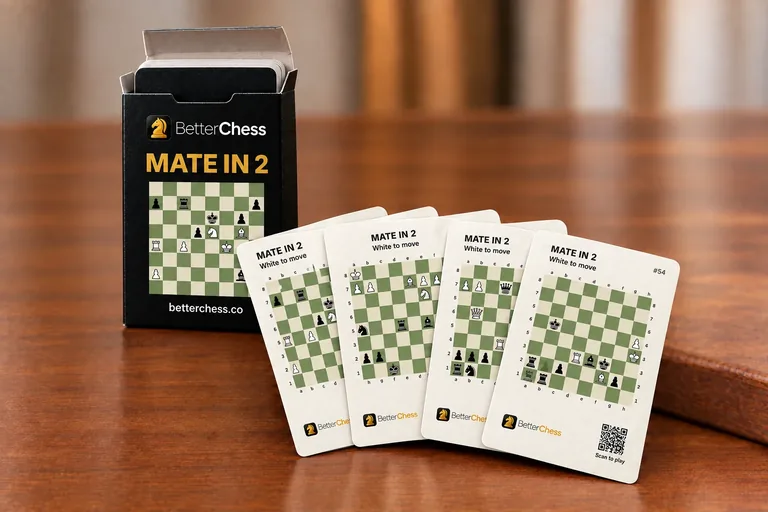
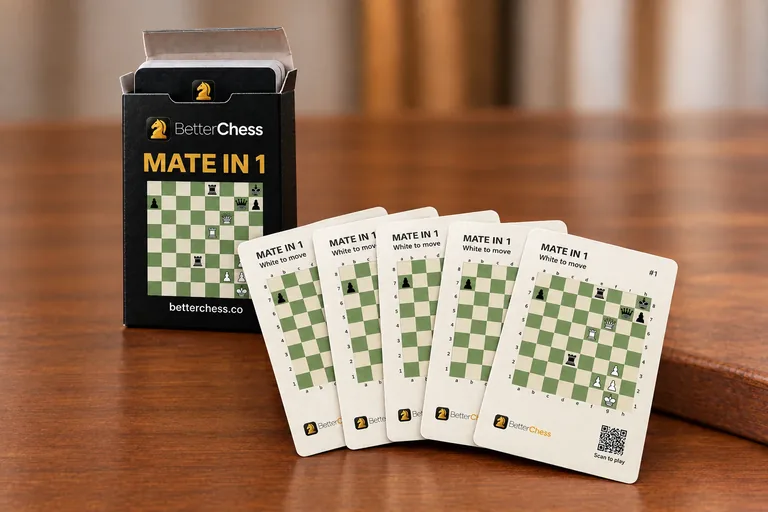
Chess puzzle playing card decks
54 poker-size cards in a tuck box. Puzzle on the front, solution on the back.