Monticelli Trap
Part of the Bogo-Indian Defense: see the full opening guide
Starting position
Engine ready — step through to see live evals.
Press ▶ Watch to play the line out, or Next to step through it — the engine evaluates every position.
The Monticelli Trap is named for the Italian champion Mario Monticelli, who sprang it against Ladislav Prokes at Budapest 1926. It arises from a completely normal Bogo-Indian with ...b6 and ...Bb7, where Black trades on c3 at the wrong moment. One knight jump, 10.Ng5!, creates two threats no single move can meet, and the a8 rook pays the bill. Even Capablanca walked into it, twice.
The idea in one line
After the routine 8...Ne4 9.Qc2 Nxc3?, White uncorks 10.Ng5!, threatening both 11.Qxh7# and 11.Bxb7 winning bishop and rook. Black's best is 10...Ne4 11.Bxe4 Bxe4 12.Qxe4 Qxg5 13.Qxa8, and White has won the exchange.
How the trap works
In the fianchetto Bogo-Indian, 8...Ne4 9.Qc2 looks like it forces Black to resolve the center, and 9...Nxc3? seems to win a pawn or at least trade fairly, since 10.bxc3 or 10.Qxc3 are expected. Instead White plays 10.Ng5!. Suddenly there are two threats: 11.Qxh7#, because the knight has left e4 and no longer blocks the c2-h7 diagonal, and 11.Bxb7 followed by taking the a8 rook on the long diagonal Black opened with ...b6. No move parries both: 10...f5 stops the mate but leaves 11.Bxb7 winning bishop and rook. The main line runs 10...Ne4 (bringing the knight back to block both diagonals) 11.Bxe4 Bxe4 12.Qxe4, and now the double threat repeats in new clothes, mate on h7 and the rook on a8. 12...Qxg5 removes the mate by killing the knight that protected the h7 invasion, but 13.Qxa8 lands anyway: White has won a rook for a knight.
The move that springs it
9… Nxc3 — 9...Nxc3? (ply 18) is the trap move. Capturing on c3 looks like the point of Black's whole ...Ne4 operation, but it sends the knight away from the kingside and leaves both long diagonals, b1-h7 toward the king and a8-h1 toward the rook, in White's hands. After 10.Ng5! Black cannot cover h7 and b7 with one move and loses the exchange in every line.
How to avoid it
As Black, the rule in these Bogo structures is: do not take on c3 while your bishop sits on b7 and your knight is the only cover on the b1-h7 diagonal. Support the e4 knight with ...f5 first, or let White initiate the trade. If you have already fallen in, follow Capablanca: 10...Ne4 11.Bxe4 Bxe4 12.Qxe4 Qxg5 13.Qxa8 Nc6 gives real compensation, the queen grabs on d4 next, and Capablanca held Euwe to draws from here in both of their 1931 games.
The full line, explained
3… Bb4+...Bb4+: the Bogo-Indian. Black develops with check and usually trades the dark-squared bishops.
8… Ne4...Ne4 gains space and hits the d2 queen's twin on c3. So far all standard theory.
9… Nxc3...Nxc3? the trap move. The knight leaves the kingside and both long diagonals light up.
10. Ng5Ng5! two threats: Qxh7 mate and Bxb7 hitting the loose a8 rook. One move cannot stop both.
10… Ne4...Ne4 is the best defense, blocking both diagonals at once. White simply removes it.
12. Qxe4Qxe4 renews both threats from the same square: mate on h7, rook on a8.
12… Qxg5...Qxg5 stops the mate by removing the knight that would guard h7. The rook cannot be saved.
13. Qxa8Qxa8: the exchange is won. Black gets pawn-grabbing play with ...Nc6 and ...Nxd4 for it.
Frequently asked
Is the Monticelli Trap a forced win for White?
No, and honest theory says so: White wins a rook for a knight, but Black gets a pawn or two plus pressure as compensation, and it is unclear whether the position is a forced win. Capablanca defended it to two draws against Euwe in 1931. At club level, though, the exchange is usually decisive.
Why doesn't 10...f5 save Black?
It only meets half the threat. The f5 pawn blocks the b1-h7 diagonal and stops Qxh7#, but the other threat still lands: 11.Bxb7 wins the bishop and then the a8 rook behind it on the long diagonal. That is the beauty of 10.Ng5: two targets, one tempo.
More traps to learn
Kieninger Trap
Budapest Gambit (1.d4 Nf6 2.c4 e5) · Checkmate (smothered)
Learn & play ›Elephant Trap
Queen's Gambit Declined (1.d4 d5 2.c4 e6) · Wins a piece
Learn & play ›Every trap works until your opponent does not play into it — and then the same move often loses a piece. That is exactly what BetterChess catches: it checks the position instead of recognising the pattern.
A trap only works if your opponent makes the mistake — strong players sidestep these, which is why each page also shows how to avoid it. Every line here is checked legal with the same engine the board runs, and every checkmate is verified.
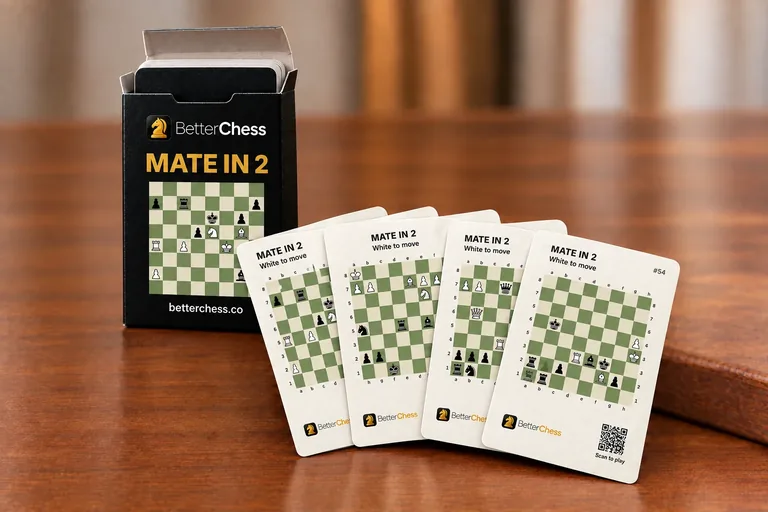
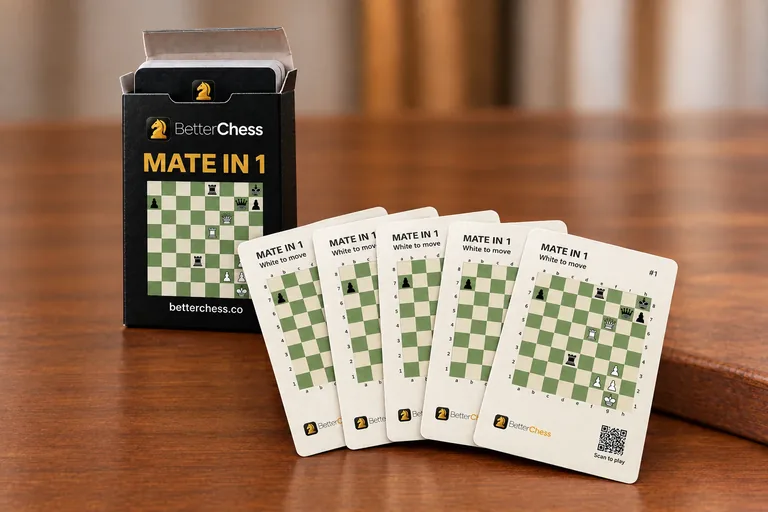
PRINTED CHESS PUZZLE CARDS
Chess puzzle playing card decks
54 poker-size cards in a tuck box. Puzzle on the front, solution on the back.