Albin Countergambit Trap
Part of the Albin Countergambit: see the full opening guide
Starting position
Engine ready — step through to see live evals.
Press ▶ Watch to play the line out, or Next to step through it — the engine evaluates every position.
The Albin Countergambit's calling card is the most famous underpromotion in chess, also known as the Lasker Trap. Black meets the Queen's Gambit with an immediate counterstrike, plants a pawn wedge on d4, and if White tries to knock it away with the natural 4.e3, that pawn marches through White's position and promotes to a knight, with check, on move seven. This page follows the punishment all the way through the capture of White's queen.
The idea in one line
After 3.dxe5 d4!, the wedge pawn is poison to attack: 4.e3? Bb4+ 5.Bd2 dxe3! and if White grabs the bishop with 6.Bxb4??, the pawn storms through with 6...exf2+ 7.Ke2 fxg1=N+!, and the skewer 8...Bg4+ wins the queen.
How the trap works
After 1.d4 d5 2.c4 e5 3.dxe5 d4, Black's advanced d-pawn cramps White. 4.e3? attacks it but walks into 4...Bb4+ 5.Bd2 dxe3!: Black ignores the attacked bishop because the pawn is worth more. Now 6.Bxb4?? loses by force: 6...exf2+! and the pawn cannot be taken, since 7.Kxf2 drops the queen immediately to 7...Qxd1. So 7.Ke2, and here comes the famous move: 7...fxg1=N+!!. Promoting to a queen would not even give check, and White would escape with 8.Qxd8+ Kxd8 9.Rxg1, restoring material equality. The knight promotion gives check, so White has no time for that: after 8.Rxg1, the skewer 8...Bg4+ ends it. Nothing can block on f3, so the king must step aside, and 9.Ke1 Bxd1 collects the queen. Even after 10.Kxd1, White has only two minor pieces for the queen and is two pawns down: a hopeless deficit.
The move that springs it
6. Bxb4 — 6.Bxb4?? (ply 11) is the point of no return. Capturing the bishop looks obligatory, since Black just left it hanging, but the pawn on e3 was the real threat all along. White had to play 6.fxe3, accepting a damaged structure; after 6...Qh4+ 7.g3 White's kingside is ugly but material is level and the game goes on. The deeper mistake was 4.e3? itself: 4.Nf3 is the correct way to meet the Albin wedge.
How to avoid it
Two layers of defense. Strategically, never play 4.e3 against the Albin: develop with 4.Nf3 and question the d4-pawn later. Tactically, if you are already in the sequence, 6.fxe3 is forced, and you should see why in advance: count what the e3-pawn does after ...exf2+ and remember that a promotion can arrive with check. The trap survives at every club level because White's moves feel forced and natural; the moment you recognize the Bb4+/dxe3 pattern, simply refuse the bishop.
The full line, explained
3… d4...d4! is the Albin wedge: the advanced pawn cramps White's queenside and sets up the whole trap.
4. e3e3? looks like the obvious refutation of the wedge. It is the start of the trouble: 4.Nf3 is correct.
4… Bb4+...Bb4+ draws White's bishop to d2 so that the capture on e3 comes with tempo against it.
5… dxe3...dxe3! ignores the attacked bishop. The passed pawn on e3 is worth more than the piece.
6. Bxb4Bxb4?? grabs the bishop and loses the game. 6.fxe3 was forced, with a damaged but playable position.
6… exf2+...exf2+! the pawn keeps eating forward. 7.Kxf2 loses the queen at once to 7...Qxd1.
7… fxg1=N+...fxg1=N+!! the famous underpromotion. 7...fxg1=Q?? gives no check, and White escapes with 8.Qxd8+ Kxd8 9.Rxg1.
8… Bg4+...Bg4+! is the skewer: no piece can block on f3, so the king must step aside and abandon the queen.
9… Bxd1...Bxd1: the queen falls. After 10.Kxd1 White has two minor pieces for a queen and is two pawns down.
Frequently asked
Why promote to a knight instead of a queen?
Because only the knight gives check. After 7...fxg1=Q?? White plays 8.Qxd8+ Kxd8 9.Rxg1 and material is level again. The knight check forces 8.Rxg1 first, and then 8...Bg4+ skewers king and queen. That single tempo is the entire trap, and it is why this is the most famous underpromotion in chess.
Is this the same as the Lasker Trap?
Yes. The line is named after Emanuel Lasker, and our Lasker Trap page shows it ending at the underpromotion itself. This page continues through the skewer and the actual capture of White's queen, because the Albin Countergambit is worth knowing as an opening in its own right: many players take it up for this trap alone.
More traps to learn
Lasker Trap
Albin Countergambit (1.d4 d5 2.c4 e5) · Wins the queen (underpromotion)
Learn & play ›Elephant Trap
Queen's Gambit Declined (1.d4 d5 2.c4 e6) · Wins a piece
Learn & play ›Every trap works until your opponent does not play into it — and then the same move often loses a piece. That is exactly what BetterChess catches: it checks the position instead of recognising the pattern.
A trap only works if your opponent makes the mistake — strong players sidestep these, which is why each page also shows how to avoid it. Every line here is checked legal with the same engine the board runs, and every checkmate is verified.
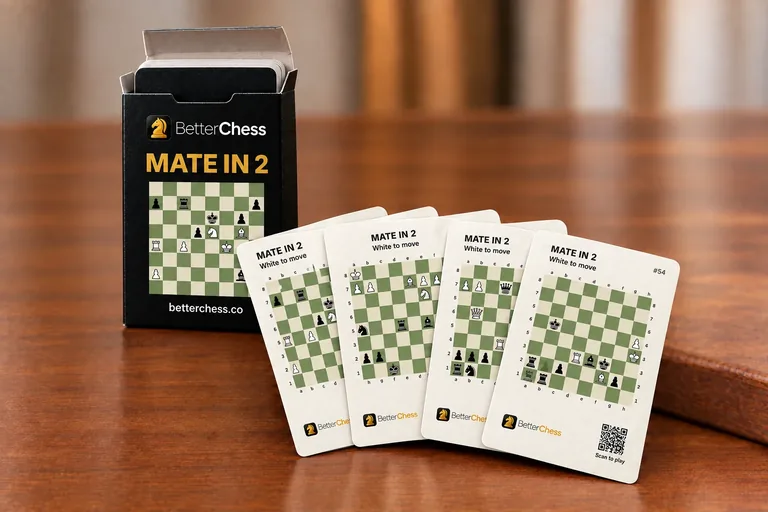
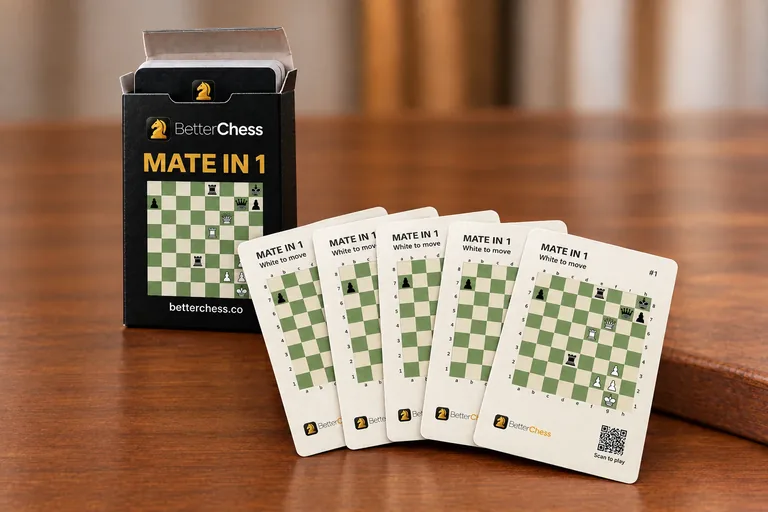
PRINTED CHESS PUZZLE CARDS
Chess puzzle playing card decks
54 poker-size cards in a tuck box. Puzzle on the front, solution on the back.