Marshall Attack
Starting position
Engine ready — step through to see live evals.
Press ▶ Watch to play the line out, or Next to step through it — the engine evaluates every position.
The Marshall Attack is the most famous gambit in the Ruy Lopez: after a normal-looking closed Lopez, Black suddenly strikes with 8...d5, giving up the e5-pawn for a ferocious kingside initiative. Frank Marshall reportedly saved the idea for years before unleashing it against Capablanca in New York 1918; Capablanca survived that game, but the gambit itself has never been refuted. A century later it remains fully sound, and many White players simply dodge it with Anti-Marshall moves.
The idea in one line
Play a normal closed Ruy Lopez, then sacrifice the e5-pawn with 8...d5, aiming every piece at White's king in a gambit that a century of theory and modern engines both approve.
Key ideas
- Castling before ...d6 is the tell: Black skips the usual closed-Lopez setup and keeps the central break ...d5 available in a single move.
- The point of the sacrifice is time: while White's queenside sleeps, Black gets ...Bd6, ...Qh4 and ...Bg4 or ...Bf5 with a direct attack on the white king.
- The e5-rook becomes a target: after Rxe5 and ...c6, Black hits it with ...Bd6 and gains yet more time to build the attack.
- Engines confirm what practice long suggested: the Marshall gives Black full compensation, which is exactly why so many White players choose Anti-Marshall systems with 8.a4 or 8.h3 instead.
Plans for each side
White: Accept the pawn, then defend cold-bloodedly: retreat the rook when hit, shore up the kingside with d4, Re1 and g3, trade off attackers whenever possible, and aim to convert the extra pawn deep in the endgame.
Black: Feed the attack: ...Bd6 and ...Qh4 come fast, supported by ...Bg4 or ...Bf5 and rook lifts. Keep pieces on, keep threats coming, and let the initiative outweigh the pawn for as long as the queens remain.
Common mistakes to avoid
- Know your moves: the Marshall is sound but concrete. Sacrificing a pawn and then hesitating is the one reliable way to get a bad game out of it.
- As White, never grab material and then play soft moves; the standard defensive setup with d4, Re1 and g3 must come quickly or the attack crashes through on h2 and f2.
- Expect the Anti-Marshall: many opponents avoid the whole line with 8.a4 or 8.h3, so a Marshall player needs a comfortable answer to those move orders too.
The main line, explained
3. Bb5Bb5 is the Ruy Lopez, pressuring the knight that guards e5; both sides follow the classical main road for now.
7… O-O...O-O is the Marshall move order: Black castles instead of the routine ...d6, keeping the central break ...d5 available in one go.
8. c3c3 prepares d4, the standard Lopez plan, and walks straight into Black's prepared idea.
8… d5...d5! is the Marshall Attack: Black gives up the e5-pawn to open lines while White's queenside is still asleep.
11. Rxe5Rxe5 wins the pawn but drags the rook forward; Black will hit it with ...Bd6 and collect more time for the attack.
11… c6...c6 is the modern main line: it secures the d5-knight and clears the way for ...Bd6 followed by ...Qh4, when the attack almost plays itself.
Frequently asked
Is the Marshall Attack sound?
Yes. It has been analyzed for a century and modern engines agree that Black gets full compensation for the pawn. Many of the world's best players have relied on it, and White's most popular reaction is simply to avoid it.
What if White declines with an Anti-Marshall?
Moves like 8.a4 or 8.h3 sidestep the gambit. Black gets a healthy closed Lopez position instead; you lose the fireworks but keep a comfortable game, so one solid setup against each is enough.
Is the Marshall too theoretical for club level?
The first dozen moves are well mapped, but the attacking scheme (...Bd6, ...Qh4, ...Bg4 or ...Bf5) is easy to remember, and at club level White rarely knows the precise defensive sequence. The gambit wins many games on energy alone.
Famous games in the Marshall Attack
- Capablanca Refutes the Marshall (1918): Jose Raul Capablanca vs Frank Marshall
More openings to explore
Ruy Lopez (Spanish)
King's Pawn (1.e4 e5) · C60–C99
Learn & play ›Berlin Defense
King's Pawn (1.e4 e5) · C65-C67
Learn & play ›Knowing the moves of the Marshall Attack is not the same as knowing why they work. Use Claude? BetterChess gives it a real engine, so it explains this opening from the board in front of you instead of from memory.
BetterChess is a practice tool — we make no guarantee you'll reach 1800 or any rating. The lines here are standard, well-established opening theory, and every move is checked legal with the same engine the board runs.
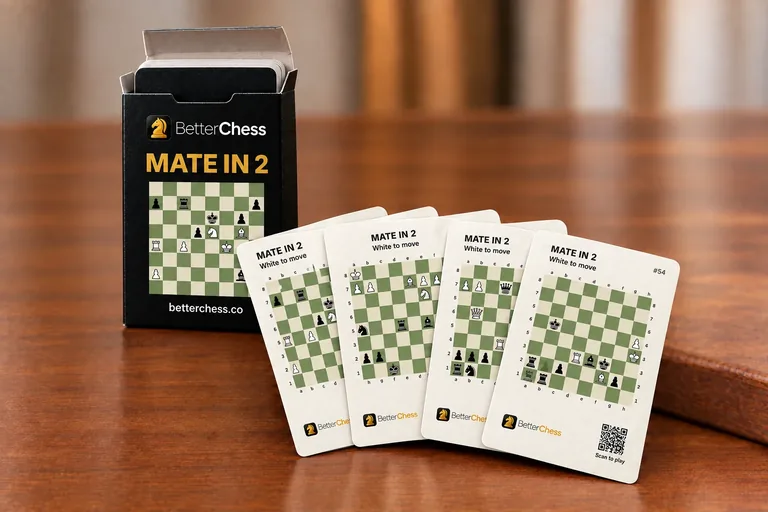
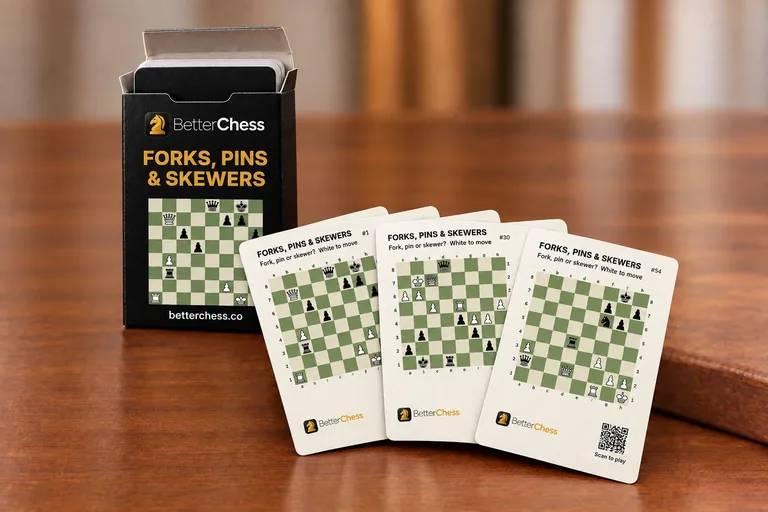
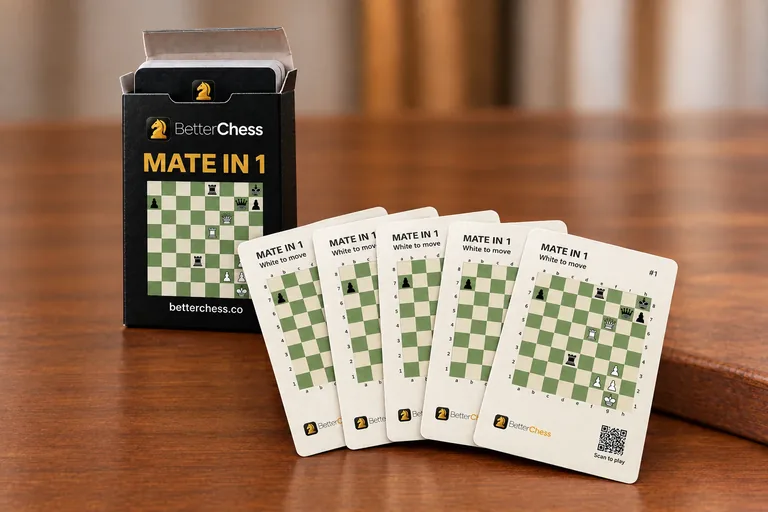
PRINTED CHESS PUZZLE CARDS
Chess puzzle playing card decks
54 poker-size cards in a tuck box. Puzzle on the front, solution on the back.