Is 900 a good chess rating?
Short answer. A 900 online rapid rating is better than roughly 73% of all rated accounts — that's novice territory. Below is what a 900 player typically does well, what holds them back, and the single most useful thing to work on next.
900 Rapid is the upper end of the beginner-to-novice climb — your tactical eye is waking up and you win a fair share of games with a clean fork or pin you actually saw coming. Blunders still happen, but now they're more often positional drift than outright giveaways: pieces ending up passive, pawns weak, the king a little airy.
The 900 player usually has no plan in quiet positions. When there's no tactic shouting at you, you tend to shuffle and wait. Learning to make a simple plan — improve your worst piece, grab a weak pawn, open a file for a rook — is what separates 900 from solidly intermediate.
When nothing is forcing, find your worst-placed piece and spend a move improving it — having any plan at all beats drifting, and it's the habit that grows out of 900.
Concepts to learn at this level
Check another rating
900 in online rapid: better than ~73% of rated players.
That's an above-the-median player — ahead of most people who hold a rating. Tier: Novice.
Where 900 sits on the online rapid rating distribution. Taller bars are more crowded rating bands.
Knowing your number is step one. The faster way up is seeing the exact move that's costing you games.
See the move that's costing you games — review a game freeSource: Rapid rating distribution (www.chess.com), retrieved 2026-06-17. Percentiles are approximate and drift over time as the player pool grows.
Nearby rating bands
Want the full ladder? The chess rating percentile hub lays out every band from 400 to 2200 with where each one lands on the distribution, plus a checker for any rating in between.
The fastest way to climb past 900
Your rating won't move because you read about it — it moves when you stop repeating the mistake that keeps costing you games. The quickest way to find that mistake is to look at a game you lost: paste it into the free game review and it marks the exact move where the evaluation flipped and explains what went wrong, in about 30 seconds, no sign-up. Pair that with the band-specific focus above, then drill the underlying ideas in our opening guides or look up any unfamiliar term in the glossary. BetterChess is a practice tool — it makes finding your weakness fast, but we make no promise of any specific rating.
Most players stuck around 900 are not losing to deep plans, they are losing pieces they did not see. Use Claude? BetterChess tells it exactly what is attacking what, computed from the board.
Frequently asked
Is 900 a good chess rating?
In online rapid, 900 is better than about 73% of all rated accounts, which puts you in the novice range. 900 Rapid is the upper end of the beginner-to-novice climb — your tactical eye is waking up and you win a fair share of games with a clean fork or pin you actually saw coming. Blunders still happen, but now they're more often positional drift than outright giveaways: pieces ending up passive, pawns weak, the king a little airy.
What should I work on at 900?
When nothing is forcing, find your worst-placed piece and spend a move improving it — having any plan at all beats drifting, and it's the habit that grows out of 900.
Related: Chess rating percentiles · Free game review · Chess openings · Chess glossary
Percentile is an estimate from published online rapid distribution data (all rated accounts) and drifts as the player pool changes. BetterChess is a practice tool — we make no guarantee that you'll reach any particular rating. Improvement depends on your own practice and effort. Product names are trademarks of their respective owners.
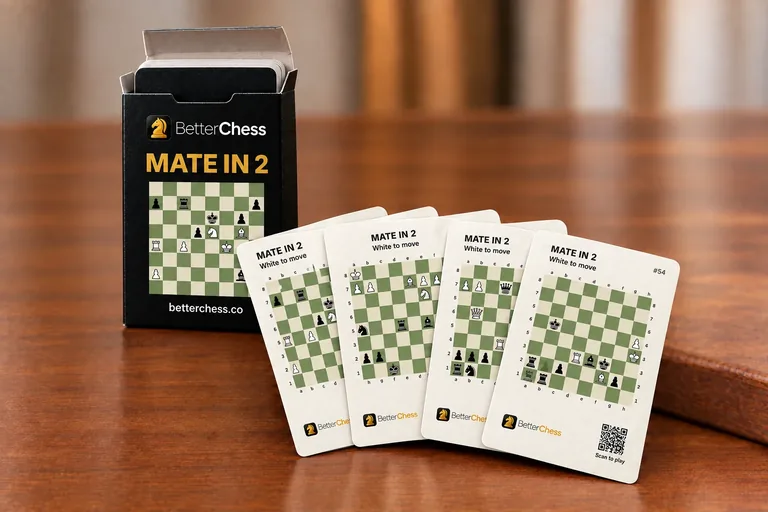
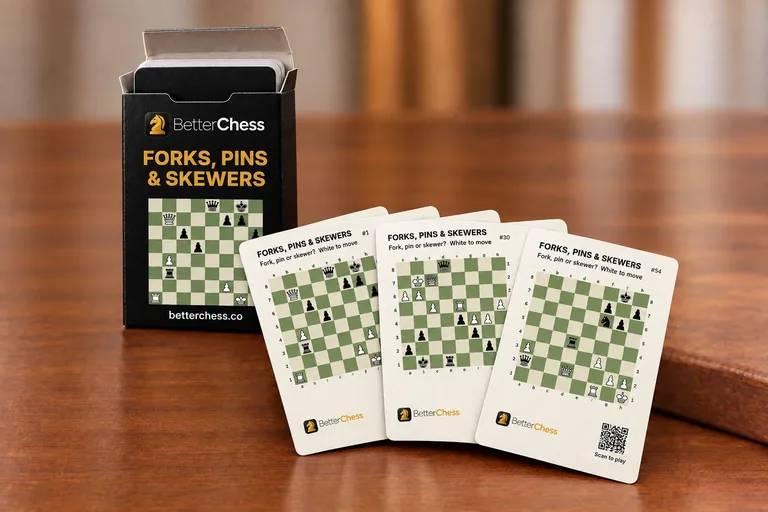
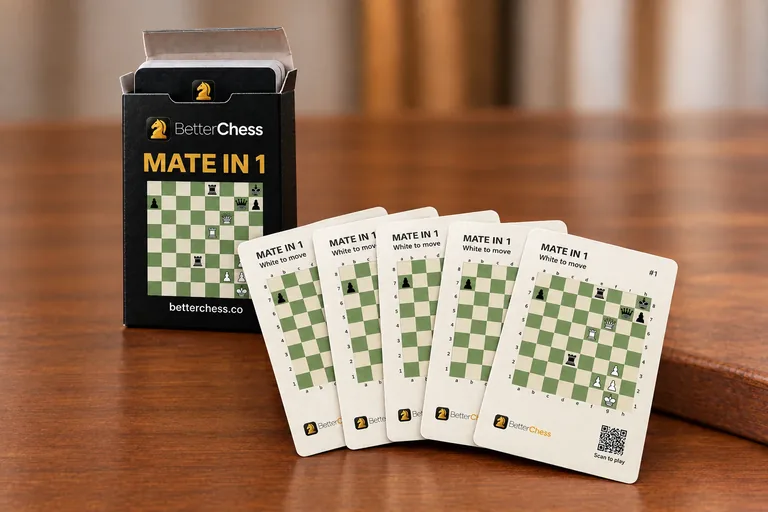
PRINTED CHESS PUZZLE CARDS
Chess puzzle playing card decks
54 poker-size cards in a tuck box. Puzzle on the front, solution on the back.